Ever Accountable – Quit Porn
- 4.5
- Rating
- 100.00K
- Installs
- Free
- Price

 Analysis by App-foxy
Changing a compulsive habit is rarely solved by installing one more app, but the right tool can make the difficult moments more visible and easier to discuss. I found that Ever Accountable takes a deliberately personal approach: instead of presenting itself as a private counter or a simple distraction blocker, it centers the process around accountability with another person. That makes it a distinctive productivity app for people who want help monitoring porn use and related habits rather than trying to manage everything alone.
The app is developed by Ever Accountable and is available as a free download for users of the supported mobile platform. Its age rating is Everyone, and it has built a sizeable audience, with over 100 thousand installs, an average rating of 4.5, and around 5.5 thousand ratings. Those figures suggest that the idea resonates with many users, although they do not tell me whether the approach will suit your personality or relationship with an accountability partner.
My overall impression is that this is less of a motivational app and more of a structure for honest conversations. That distinction matters. If you are looking for a private habit tracker, a meditation guide, or a broad productivity suite, this is probably not the best match. If you already have someone you trust and want a practical way to make a sensitive goal less isolated, it becomes much more interesting.
You May Also Like

 Blood Strike: 2.5 Anniversary
Blood Strike’s Loadouts Turn Every Drop Into a Tactical Gamble
A close look at Blood Strike’s custom loadouts: how fast access to signature weapons reshapes its battle royale rhythm, rewards preparation, and narrows the gap between fights.

 Pandora - Music & Podcasts
Pandora’s Music Is Easy to Start, but Harder to Recover
Pandora’s strength is its low-effort path from a seed to a station. Its weak spot is how much confidence it asks you to place in connection, setup, and quiet recovery.

 8 Ball Pool
 Is Built on Rivalries, Rematches, and Routine
A close look at the rivalries, rematches, shared routines, and unanswered safety questions that turn a quick pool match into a persistent mobile community.

 Samsung Music
’s Quiet Strength Is Playing What You Already Own
Its reach comes less from spectacle than from dependable access to a personal library. That simplicity is both the app’s strongest retention engine and its ceiling.

 AccuWeather: Weather Radar
AccuWeather Review: A Quick, Clear Forecast for Everyday Decisions
For everyday plans, the best forecast is the one you can understand quickly. AccuWeather makes rain timing, radar, and local conditions easy to act on, with a few trade-offs.

 Hill Climb Racing
Why Hill Climb Racing Still Turns Crashes Into One More Run
A tiny car, a bumpy hill and one more upgrade: Hill Climb Racing keeps resurfacing because its simple chaos makes every near-miss feel personal.
More From Our News Desk
View All News


How the free access and paid value fit together
I’d treat the free starting point as a way to test whether involving another person makes your routine more useful, rather than assuming the download alone will change a habit. Before considering a purchase, I’d identify what I actually rely on and check the terms of the specific item; the listed in-app prices span $3.99 to $149.99. That makes it worth looking closely at the choice before moving on to how the app fits into everyday use.
What you can expect before paying
The app is listed as free, so you can begin without an upfront purchase. That is useful for a sensitive subject because it lets you decide whether the accountability model feels comfortable before committing money. I would treat the free entry point as a chance to test the habit, the communication style, and the relationship with your chosen partner—not as proof that every part of the experience is permanently available at no cost.
There are in-app purchases ranging from $3.99 to $149.99 per item. That is a broad range, so I would avoid assuming that the lowest price represents the complete experience or that the highest price is necessary for ordinary use. The sensible approach is to start with the free access, identify which part of the routine you actually use, and then judge any upgrade against that specific benefit.
For me, the important cost question is not simply whether the download is free. It is whether paying would add enough accountability or convenience to justify the expense over time. A person who checks in consistently and sees the app as part of a serious recovery plan may find paid access easier to justify than someone who installs it during a moment of motivation and stops opening it a week later.
What the price does and does not guarantee
Because the purchase range is so wide, I would read the purchase screen carefully before confirming anything. Look at whether the option is a one-time item or part of a continuing commitment, what period it covers, and which part of your routine it changes. Those are practical questions, not minor details, especially when the most expensive listed item is far beyond the cost of a casual productivity download.
I also would not choose the app solely because it is free to install. The real value is behavioral: does it help you pause before acting, report honestly, and stay connected to the person supporting you? If the answer is no, even a low-cost purchase would be poor value. Conversely, if the structure helps you maintain a difficult goal, the cost may be easier to view as support for a process rather than payment for entertainment.
Where the app’s value comes from
The strongest idea here is accountability. Many habit apps keep information between the user and the screen. That can be comfortable, but it also makes it easy to dismiss a skipped check-in or quietly reset a goal. Ever Accountable is built around bringing another human being into the process, which changes the emotional weight of the routine. The app is valuable when that added visibility encourages honesty without turning the relationship into surveillance.
That balance is essential. An accountability partner should be someone who can listen, respect boundaries, and respond calmly. Choosing a person simply because they are nearby or forceful may create shame instead of progress. Before using the app seriously, I would agree on what support means, how often you will communicate, and what should happen after a setback. The technology can organize the process, but it cannot repair a poor agreement between two people.
One practical workflow is to use the app at a fixed point in the day, then discuss patterns rather than only failures. For example, an evening check-in can become a short review of what made the day easier or harder: boredom, stress, being alone, late-night phone use, or a difficult emotional event. That turns the tool from a confession box into a way to notice triggers and plan a different response next time.
A realistic day-to-day scenario
Imagine someone who usually loses control after working late, when they are tired and scrolling without a clear purpose. Instead of waiting until the urge is intense, they use the app as part of a pre-agreed evening routine. They check in with their accountability partner, identify that late-night isolation is the recurring risk, and make a concrete plan for the next evening—putting the phone away earlier, calling the partner, or moving to a shared room.
The useful part is not a dramatic promise to change forever. It is the short loop between noticing a pattern, telling another person, and choosing a smaller action before the familiar situation repeats. In my view, that is where the app can outperform a private streak counter. A counter records an outcome; accountability can create a conversation before the outcome happens.
Why the human element is also the main limitation
The same feature that makes the app distinctive can make it uncomfortable. Some users will not want to discuss porn use with a friend, partner, mentor, or family member. Others may have someone willing to help but no clear agreement about privacy or boundaries. If you need complete discretion, a private journal or offline habit tracker may feel safer and be easier to maintain.
There is also a risk of treating disclosure as the entire solution. Reporting a behavior does not automatically address loneliness, anxiety, relationship difficulties, or compulsive patterns. If the habit is causing serious distress or interfering with daily life, an accountability app should sit alongside appropriate professional support rather than replace it. I would especially avoid making a single friend responsible for handling situations that require clinical care.
How it compares with ordinary productivity tools
Typical productivity apps focus on tasks, calendars, reminders, or time management. They are useful when the main problem is forgetting an appointment or failing to organize work. Ever Accountable addresses a more personal kind of friction: the gap between an intention and what happens when no one else can see the struggle. That makes it more specialized than a standard task manager.
A private habit tracker may offer cleaner charts and a simpler experience. It can be the better option for someone who wants to record urges, identify patterns, and keep the process entirely personal. A website blocker may be better for someone whose main need is immediate technical friction around particular browsing situations. Ever Accountable is most compelling when the missing ingredient is not information or blocking, but a trusted person who helps turn intention into responsibility.
I would therefore avoid comparing it as if it were a general replacement for every productivity tool. It is not the app I would choose to manage work projects, plan a study schedule, or track exercise. Its value comes from a narrow but meaningful focus on accountability around bad habits and porn addiction. That specialization is a strength for the right user and a reason to skip it for everyone else.
Three ways to use it more effectively
First, agree on a response to setbacks before the first difficult moment arrives. If every lapse leads to anger, interrogation, or vague disappointment, the user may hide information and the system loses its purpose. A better agreement might focus on reporting quickly, identifying the trigger, and choosing one adjustment for the next day. This is a relationship design issue that many people overlook when they think the app alone will create accountability.
Second, use check-ins to record context, not just success or failure. The most helpful detail may be the situation that came before the urge: fatigue after work, conflict, unstructured time, or a particular device routine. Over time, those observations can point to prevention strategies. The app becomes more useful when it supports a conversation about causes instead of reducing progress to a number.
Third, keep the accountability partner’s role limited and sustainable. A daily message can be valuable, but an arrangement that demands constant availability may collapse under its own weight. Decide what counts as an urgent request, what can wait for a scheduled conversation, and how to handle travel or busy periods. This protects the relationship and makes the routine more likely to last.
Who is likely to get the most value
I would recommend trying it to an adult who has already recognized a recurring problem and genuinely wants another person involved. It can suit someone who has made private promises repeatedly but finds that those promises disappear during stressful or isolated moments. It may also help couples or friends who want a defined support routine rather than relying on awkward, spontaneous conversations.
The app is particularly promising when the accountability partner is supportive without being controlling. The user should be willing to report honestly, including imperfect days, and the partner should understand that encouragement is different from policing. If both people accept that progress can include setbacks, the structure has a better chance of becoming useful instead of punitive.
It may also be worth trying for someone who has already used a blocker or a journal and discovered that technical restrictions alone are not enough. A blocker can interrupt access, while a journal can reveal patterns; accountability adds social pressure and support. Combining approaches may be more practical than expecting one app to solve every part of the habit.
Who should probably skip it
I would skip it if you are not ready to involve another person. That is not a moral judgment; it is simply a mismatch with the app’s central idea. If privacy is your highest priority, choose a personal tracker instead. If your goal is broad productivity, there are more suitable tools designed around tasks and schedules rather than sensitive behavior.
I would also be cautious if you are considering it as a punishment system. Shame can make a compulsive habit harder to discuss, and an accountability partner who uses the app to monitor or threaten you is unlikely to create healthy progress. In that situation, professional guidance or a carefully chosen private method may be safer and more constructive.
Device and version considerations
The current version is listed as 23-25-621-2026-08-24, and the minimum operating system is Android 11. That means users on older Android versions should check compatibility before planning around the app. The version label is unusually detailed, but I would focus less on the number itself and more on whether your device can install and run the current release.
Since this is a mobile app, I would also think about when you will use it. A tool that sits on the same phone associated with the habit may be convenient, but it can also place the accountability routine close to the temptation. A scheduled check-in in a shared space may work better than opening it privately in bed. That small environmental choice can make the difference between a deliberate routine and another unplanned scrolling session.
My final decision on its value
After looking at the free entry point, the paid purchase range, and the app’s focused purpose, I see Ever Accountable as a specialized tool rather than a universal answer. I like that it addresses the social side of changing a habit, because private intentions often weaken when stress and isolation arrive. I also appreciate that the free download lets you test the approach before deciding whether paid access has a place in your routine.
My reservation is that the app’s success depends heavily on the quality of the accountability relationship. The wrong partner can create pressure without support, while no partner leaves the central mechanism unused. The broad in-app purchase range also means I would not buy impulsively; I would first establish a routine and verify exactly what a paid item provides.
My recommendation is to try the free version if you want a trusted person involved and you are prepared to have honest, respectful conversations. Skip it if you want a completely private tracker, a general productivity planner, or a technical blocker as your main solution. For the right user, its strongest feature is not a clever screen or a motivational slogan. It is the simple, difficult act of making a personal goal visible to someone who can help you keep working on it.
FAQs for Ever Accountable – Quit Porn
01What is Ever Accountable – Quit Porn and how does it work?
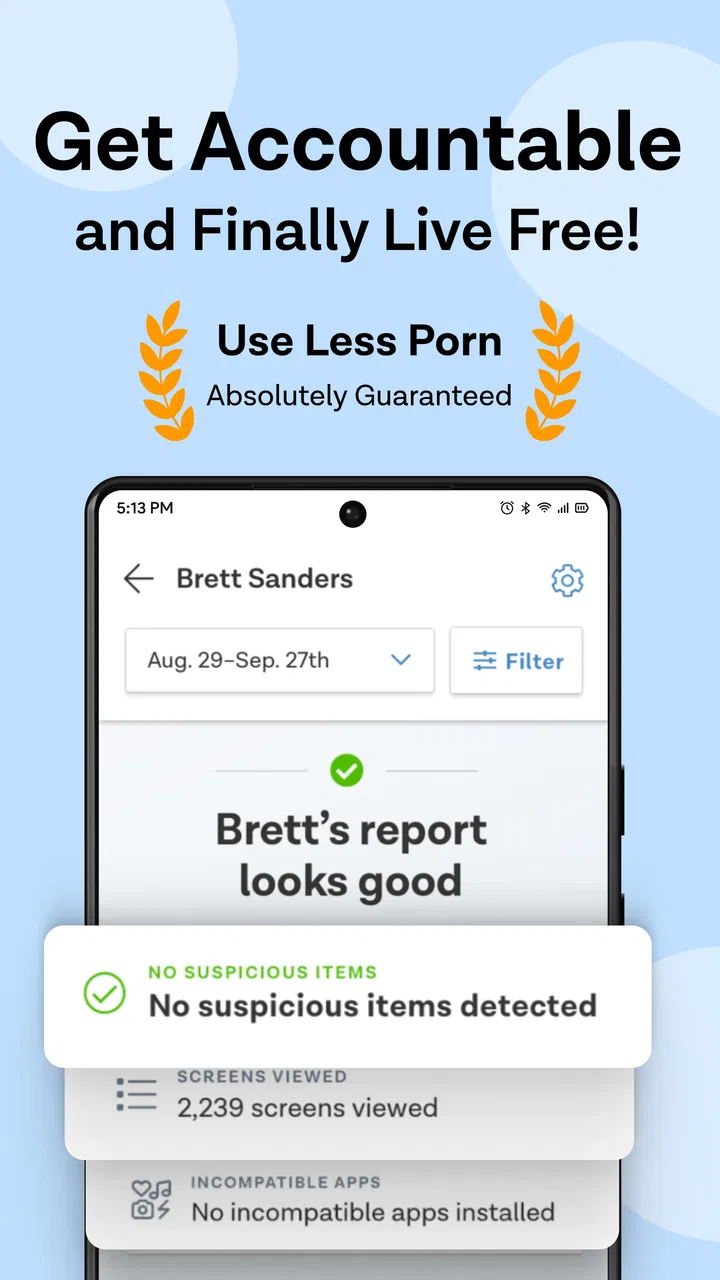
Ever Accountable – Quit Porn is an accountability and digital-wellbeing app designed to help users reduce or quit pornography use. It typically monitors activity on supported devices and provides reports to a trusted accountability partner. The app is intended to encourage honesty, awareness, and healthier habits rather than simply blocking content, so users should review its monitoring features and permissions before setup.
02Does Ever Accountable – Quit Porn block pornography automatically?
The app may offer filtering, alerts, or monitoring features, but it should not be treated as a guaranteed replacement for personal boundaries or device-level parental controls. Its main purpose is accountability: activity reports can make potentially problematic browsing more visible to a selected partner. Exact blocking and detection capabilities may vary by operating system, browser, subscription plan, and current app version.
03What information does Ever Accountable share with an accountability partner?
Ever Accountable is built around sharing selected activity information with a trusted accountability partner, which can include browsing or app-use reports and alerts related to potentially inappropriate content. The precise details depend on the permissions you grant, your device, and the service settings. Before inviting someone, read the privacy policy and review what data is collected, stored, and shared.
04Is Ever Accountable – Quit Porn free to use?
The app may be available to download without an upfront charge, while some monitoring, reporting, or support features can require a paid subscription or trial. Pricing, renewal terms, and available features may differ between Android and iOS. Check the relevant app-store listing before subscribing, and remember to cancel through the correct store if you decide not to continue after a trial.
05Can Ever Accountable help me quit pornography completely?
Ever Accountable can provide structure, reminders, accountability, and greater awareness of online habits, but no app can guarantee complete recovery or permanent abstinence. Results depend on consistent use, an honest relationship with an accountability partner, and personal changes outside the app. Users experiencing compulsive behavior may also benefit from a qualified therapist, support group, or other professional help.
Pros
- Tracks browsing habits across devices for greater accountability.
- Accountability partners can receive activity reports and alerts.
- Supports website and app monitoring on Android devices.
- Focuses on privacy by sharing activity summaries
- not private messages.
- Useful for setting personal boundaries and maintaining recovery routines.
Cons
- Some monitoring features require a paid subscription.
- Accountability may feel intrusive for users wanting complete privacy.
- Reports can create tension if shared activity is misunderstood.
- Effectiveness depends on choosing a reliable accountability partner.
- iOS capabilities may be more limited than Android monitoring features.

Ever Accountable – Quit Porn
Gallery